The Hidden Cost of Manual Appointment Scheduling for Service Businesses


The Hidden Cost of Manual Appointment Scheduling for Service Businesses
There is a particular kind of work that takes up a lot of time without ever appearing on a to-do list.
Scheduling appointments is one of them.
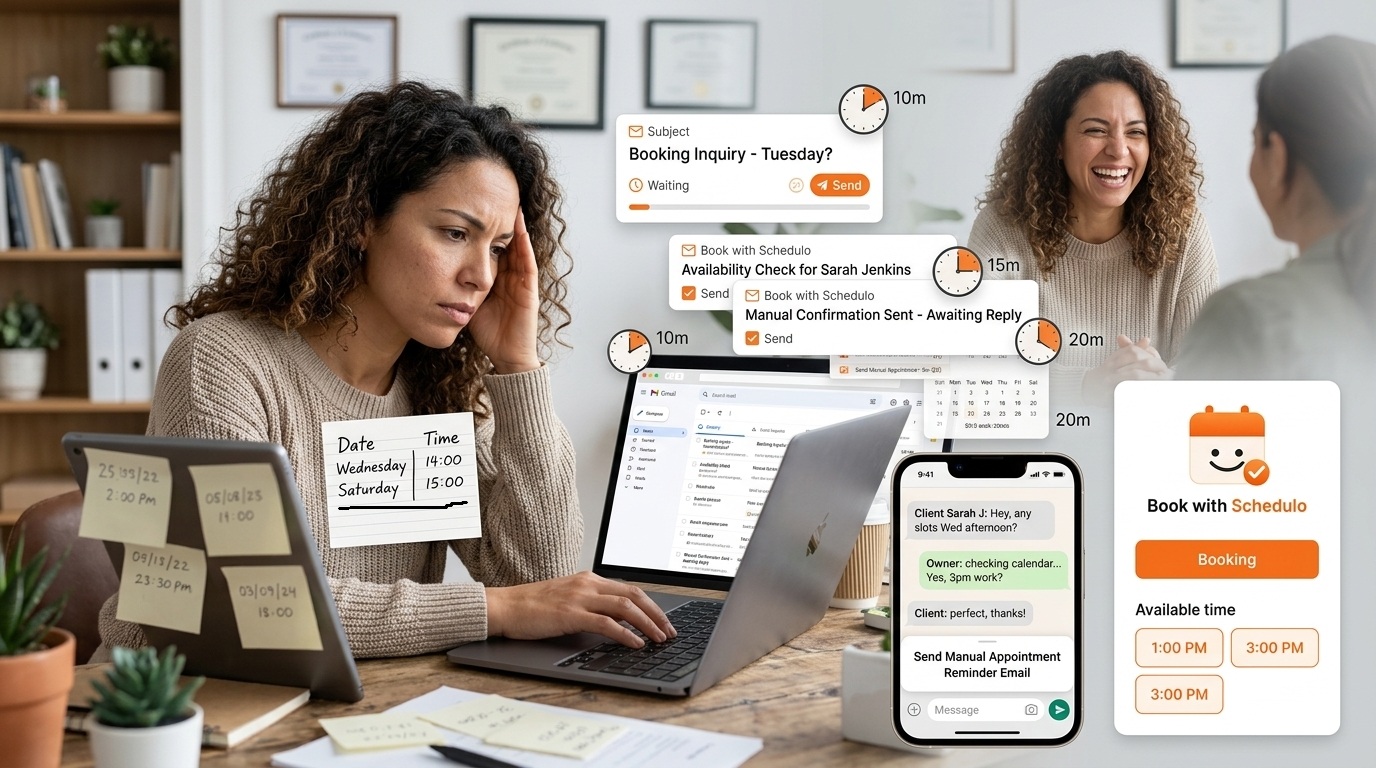
A customer sends a message asking if you're free on Thursday. You check the calendar and reply with two available times. They come back a few hours later and choose one. You add the appointment, send a confirmation and move on.
Then another customer asks to change their appointment.
Then someone calls while you're in the middle of a meeting.
Then you realise that the appointment you thought was confirmed was actually still waiting for a reply.
None of these things is difficult. That's exactly why manual scheduling can be easy to overlook.
When you're running a small service business, doing these tasks yourself can feel normal. You know your customers, you know your calendar and there may not seem to be enough appointments to justify changing the system.
But as bookings increase, the problem isn't really the calendar anymore.
It is everything around it.
Manual scheduling creates a lot of small interruptions
The biggest problem with manual scheduling isn't necessarily the amount of time one booking takes.
It is the number of times you have to stop what you're doing.
Imagine you're a consultant working on a client project. A message arrives:
"Are you available tomorrow afternoon?"
You stop working, open your calendar, check your other commitments and reply.
A little later:
"Can we do 4 instead?"
You check again.
Then:
"Actually, Friday would be better."
You check again.
The appointment eventually takes place, but the scheduling conversation has interrupted your work several times.
This is especially frustrating for businesses where the person handling bookings is also the person delivering the service.
A consultant, coach, tutor, therapist, freelancer or independent professional doesn't have a separate scheduling department. Every scheduling task comes directly out of the same limited working day.
That is where the hidden cost starts to become noticeable.
Your availability shouldn't depend on when you can reply
Customers don't necessarily want to book an appointment when you're sitting at your computer.
They might find your business late at night. They might have a few minutes during their lunch break. They might see your service on social media and decide they want to book immediately.
If the only way to make an appointment is to send a message and wait for a response, there is an unnecessary gap between interest and booking.
That gap doesn't always result in a lost customer.
But sometimes it does.
People get distracted. They forget. They find another business that makes booking easier. Or they simply don't want to start a conversation just to find out when you're available.
This is one of the more practical reasons businesses move towards online appointment booking.
Instead of making availability a conversation, the business can show customers the times that are actually available and let them choose one.
The business still controls its working hours. The difference is that the customer doesn't need to wait for someone to manually coordinate the appointment.
The calendar becomes harder to trust
Manual scheduling also creates another problem that is less obvious: over time, it becomes difficult to know which information is correct.
Maybe one customer confirmed an appointment through WhatsApp.
Another was booked over the phone.
A third appointment is in your calendar.
Someone else asked to reschedule but you haven't updated the calendar yet.
Now you're relying on memory, messages and calendar entries at the same time.
This is where double bookings can happen.
It doesn't necessarily mean the business is badly managed. It simply means that information is being updated manually in different places.
One small mistake can then create several more tasks.
You have to contact one customer, explain the situation, find another time, change the calendar and make sure the replacement appointment is actually confirmed.
The original scheduling mistake might have taken 30 seconds.
Fixing it can take much longer.
No-shows are another cost of an appointment that looked successful
A booking appearing on the calendar doesn't necessarily mean the customer will turn up.
Anyone who runs an appointment-based business has probably experienced this.
You keep an hour free.
You prepare for the appointment.
The time arrives.
Nothing.
The frustrating part is that the business can't recover that hour once it has passed. If another customer could have used that slot, the opportunity is gone.
Not every no-show can be prevented. People have emergencies and genuine reasons for missing appointments.
But forgotten appointments are different.
A customer may have booked something two weeks ago and simply forgotten about it.
That is why reminders are useful. They don't require the business owner to remember who needs to be contacted and when.
For example, automatic appointment reminders can give customers a simple reminder before their scheduled time without creating another manual task for the business.
It is a small piece of automation, but it addresses a very real problem: a customer can forget an appointment even when the business hasn't.
For more practical ideas around this problem, see our guide on how to reduce appointment no-shows.
Rescheduling shouldn't require another conversation
Booking isn't the only part of appointment management that takes time.
Customers change their plans.
A client who booked Wednesday morning may need Friday instead. A student might have an exam. A customer may suddenly have a work commitment.
With manual scheduling, the business usually has to handle the entire conversation.
The customer asks to move the appointment.
You check your calendar.
You suggest another time.
They ask for something else.
You check again.
Once they choose a new time, you update the old appointment and create the new one.
If this happens once a week, it may not matter.
If it happens several times a day, it becomes part of the job.
Allowing customers to manage their own appointments can remove a surprising amount of this back-and-forth.
The important part is that the customer should only be able to choose from times that are genuinely available. Otherwise, you're simply moving the same scheduling problem to a different screen.
Manual scheduling also affects how professional a business feels
There is another cost that is harder to measure.
The booking experience says something about the business.
A customer who has to send three messages to arrange a 30-minute consultation may wonder why something so simple is difficult.
On the other hand, a customer who can immediately see available times, choose one and receive a confirmation doesn't have to think about the scheduling process at all.
That doesn't mean every business needs an elaborate booking system.
In fact, simplicity is usually better.
The customer should be able to answer three basic questions quickly:
What am I booking?
When can I book it?
What happens after I book?
If those answers are clear, the booking process is doing its job.
There is also a missed-opportunity cost
This is probably the hardest cost to see.
Suppose someone discovers your business at 9 PM.
They are interested enough to book, but your process says, "Message us for availability."
They send a message.
You don't see it until the next morning.
By then, the customer has moved on to other things.
You may never know that person was ready to become a customer.
This is different from a customer explicitly saying no.
There is no cancellation. No negative review. No notification telling you that you lost the booking.
The opportunity simply disappears.
For businesses that depend heavily on appointments, being able to accept bookings when the owner isn't actively working can therefore be useful.
A booking page can keep working even when the business owner is asleep, serving another customer or away from their phone.
The problem becomes bigger as the business grows
Manual scheduling has one advantage: it costs almost nothing to start.
That's why so many businesses begin with it.
A freelancer with three clients can easily manage a calendar.
A coach with five appointments a week can probably handle the scheduling through WhatsApp.
A consultant who only receives a few enquiries doesn't necessarily need to automate everything.
The problem comes when the volume changes but the process doesn't.
Twenty appointments are different from five.
Fifty are different from twenty.
At some point, the owner isn't simply scheduling appointments anymore. They're spending part of every day maintaining the scheduling process.
That is usually the point at which appointment scheduling software starts making sense.
Not because the business suddenly became "big enough" for software.
Because the manual process has become expensive enough in terms of time and attention.
What should actually be automated?
The answer isn't "everything."
A good starting point is the repetitive part of the booking process.
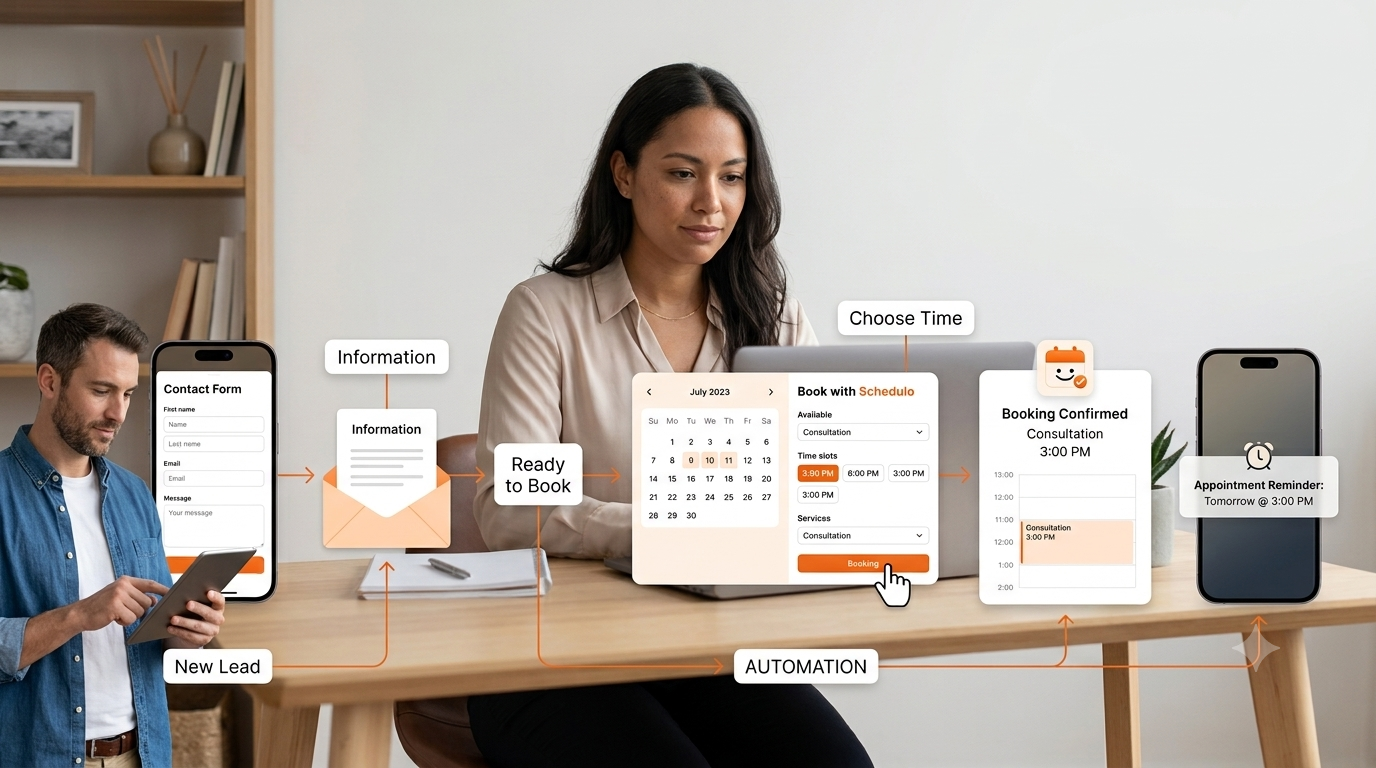
Customers should be able to see your availability and book without waiting for a reply.
The appointment should be added to the appropriate calendar.
The customer should receive confirmation.
Reminders can be sent before the appointment.
And, where appropriate, customers should be able to reschedule or cancel without starting another conversation.
Some businesses may also want to collect payment when the appointment is booked.
That can be particularly useful when the service has a fixed price or when the business wants a deposit to reserve the time.
The idea isn't to make the customer interact with more technology.
It is actually the opposite.
The technology should stay in the background so that the customer has fewer things to do.
Even offline businesses can benefit
Online booking doesn't mean customers have to discover the business online.
A salon can put a booking QR code on its counter.
A consultant can put one on a business card.
A freelancer can add a booking link to an invoice.
A coach can share it through WhatsApp.
A business that meets customers in person can give someone a way to book their next appointment before they leave.
A QR code can be particularly useful here because it connects an offline interaction to the booking page with very little effort. The customer scans it with their phone and can go straight to the available appointment times.
The important part isn't the QR code itself.
It's removing another step between the customer deciding to book and actually booking.
How do you know when manual scheduling has become a problem?
There isn't a magic number of appointments that tells every business when to automate.
Instead, look at what is happening during a normal week.
Are you regularly answering messages about availability?
Do customers have to wait for you before they can book?
Have you had a double booking?
Do you spend time sending reminders manually?
Do customers frequently ask to reschedule?
Have you ever forgotten to update an appointment after a change?
Do you sometimes discover booking requests hours after they were sent?
If several of these sound familiar, the issue probably isn't that you need to work faster.
The process itself may need to change.
Manual scheduling isn't always wrong. Staying manual forever can be.
There is nothing inherently wrong with managing appointments yourself.
For a small business with a handful of customers, it can be perfectly practical.
The mistake is assuming that because the process works today, it will continue to work as the business grows.
At some point, the owner becomes the connection between the customer and the calendar.
Every booking needs them.
Every change needs them.
Every reminder needs them.
Every scheduling mistake comes back to them.
That creates a bottleneck.
And the irony is that the business may have adopted manual scheduling to keep things simple, only to eventually make itself responsible for every small scheduling decision.
The real value of online appointment scheduling isn't simply having a nicer calendar.
It is giving customers a way to book without waiting for you, while giving you back the time you were spending coordinating those bookings.
For a service business, that time can be worth considerably more than the cost of the scheduling tool itself.
Because the hidden cost of manual scheduling isn't the few minutes spent arranging each appointment.
It's all the other work, interruptions and missed opportunities that accumulate around those few minutes.
If you're ready to replace some of that manual work with a simpler booking process, Book with Schedulo brings online booking, calendar availability, confirmations, reminders and appointment management together in one workflow.